Evidence summary: Shared decision making for mental health - what is the evidence? (headspace)
National Youth Mental Health Foundation headspace is funded by the Australian Government under the Promoting Better Mental Health – Youth Mental Health Initiative Evidence Summary: Shared decision making (SDM) for mental health – what is the evidence?
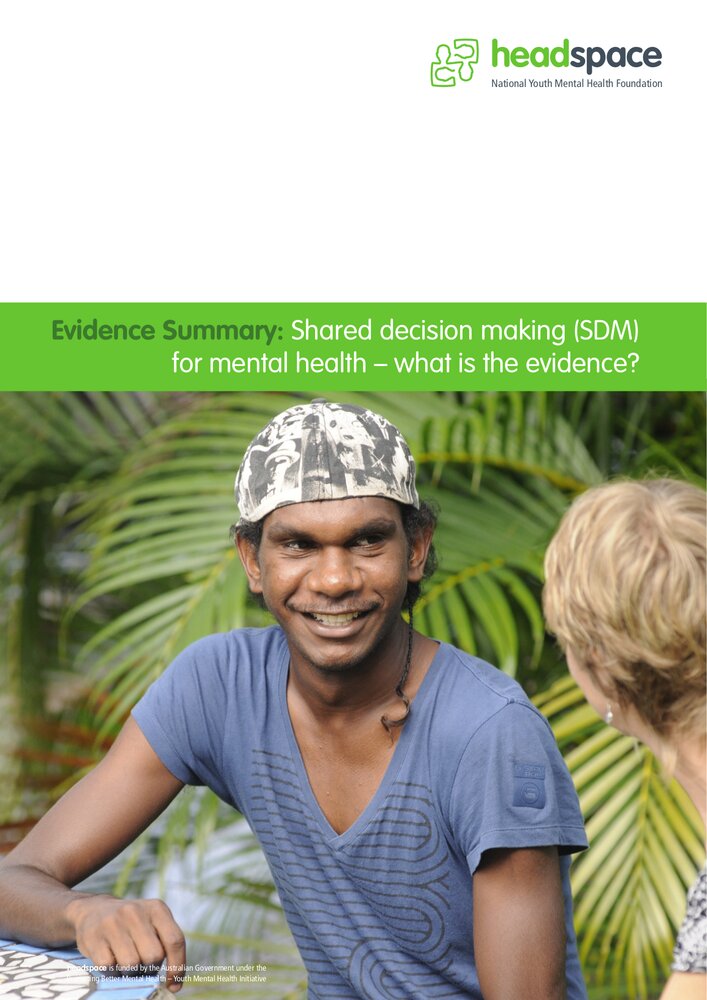
A man is wearing a blue shirt and has on a white hat. He is smiling at the camera. There is another woman next to him with blonde hair also looking at his phone. Behind them are green palm leaves.
Evidence Summary: Shared decision making (SDM) for mental health – what is the evidence? Section A: Heading 2 Evidence Summary: Shared decision making (SDM) for mental health – what is the evidence? Introduction Health professionals are increasingly being encouraged to adopt a collaborative approach to making health care decisions. Clinical practice guidelines advocate for clinicians to involve clients in decision-making processes and allow for client preferences (along with evidence) to guide decisions where possible. Shared decision making (SDM) is the most prominent example of this. While this approach has strong face validity, it is a relatively new approach in the area of mental health, and evidence for the effectiveness of collaborative approaches is only just emerging. Decision-making processes for clients diagnosed with mental disorders might also be different to those in general or non-psychiatric health areas. This evidence summary will review available evidence for the effectiveness of SDM for mental disorders and related research about the effectiveness of components of SDM such as allowing clients to choose treatment options. What is shared decision making? SDM is an approach to treatment decision making that involves collaboration between a clinician and a client. Multiple health professionals and/or caregivers may also be involved. SDM promotes the selection of a treatment choice that is based on both evidence and client preferences. The stages of SDM include: 1) two-way exchange of information between clinician and client (the clinician communicates information about the suitable treatment options and the potential risks and benefits of these options, while the client communicates information about their values and preferences about these treatment options); 2) deliberation on this information (the clinician and client discuss these possible outcomes and values and preferences); and 3) selection of an option that is consistent with the values and preferences of the client (1, 2). It is also important to make a time to review this decision (see Suggested Steps). Decision aids Decision aids are paper based or online tools that facilitate SDM. Decision aids clarify the decision to be made, explain appropriate treatment options, present evidence about the potential risks and benefits of each option, and encourage the client to explore their values and preferences about these possible risks and benefits. The International Patient Decision Aid Standards (http://ipdas.ohri.ca/) provide guidance about what constitutes a good quality decision aid. A systematic review of decision aids across all health areas found that decision aids increase clients' knowledge of treatment options; give clients more realistic expectations about the potential risks and benefits of these treatment options; help clients to make a decision that is more in line with their personal values; and be more involved in the decision making process (3). Aren't we already doing this in mental health? Although clients may receive aspects of SDM (e.g. being involved in making decisions in some way) it is unlikely that a comprehensive SDM approach is used. For example, three studies that have used a standardized measure of SDM found on average clinicians performed poorly on most SDM behaviours (4-6). No studies have measured systematically the extent to which young people diagnosed with mental disorders receive a SDM approach to treatment decision making. Do clients want to be involved? Overall, preference for involvement in healthcare decisions appears to have increased in recent years. A recent review (7) of patient preference for involvement in treatment decision making for both mental disorders and non-mental disorders showed that rates of desire for this type of involvement were 50% in studies published before 2000 and 71% in those published between 2000-2007. Although some of this increase may be a result of measurement differences over time, it may also reflect the growing shift towards more client centred care. Generally studies show that individuals who are female, young and more educated are more likely to prefer involvement (7-10). Looking at mental disorders specifically, there is evidence to suggest that adults diagnosed with mental disorders will want at least some involvement in treatment decision making (8, 11-13), and some studies have shown that in fact those with mental health disorders may be more likely to want involvement than those with general medical conditions (14-16). Involving young people in their own mental health care Far less research has been done investigating young peoples' preference for involvement in treatment decision making. However, it is clear that young people have opinions about what sort of interventions they prefer. For example, in a study of 444 depressed young people aged between 13 and 21 years being seen in primary care, counselling was the most preferred option (17). A small, qualitative study explored the experiences and beliefs of young people diagnosed with depressive disorders and found that although most clients wanted some involvement, the desire for involvement varied across participants and also over time for each participant (18). SDM allows for flexibility in the level of involvement, and discussing preferred level of involvement is a step in the SDM process. Can young people with mental disorders be involved? It is important to consider the capacity of young people diagnosed with a mental disorder to be involved in treatment decision making given both their age and clinical condition. Laws and policy regarding age of consent will vary according to geographical location. There is little research investigating the decisional capacity of young people diagnosed with mental disorders specifically, however there have been recent calls for adolescents (particularly those aged 14 years and older) to be deemed competent to provide informed consent for participation in research studies (e.g. (19-22)). Decision making for young people diagnosed with mental disorders is likely to be complex, and the point at which adult input is required needs to be assessed on an individual basis (23-25). Shared decision making for mental health Reviews of SDM in mental health describe the small body of work emerging in the area (26, 27). Two additional high quality studies have been conducted since these reviews (28, 29) and, together with the earlier studies (e.g. (30-32)), SDM interventions for depression, schizophrenia, substance use and other serious mental disorders appear to improve client involvement, satisfaction, and in one study, mental health outcomes. All of these studies have been conducted with adult participants.
Evidence Summary: Shared decision making (SDM) for mental health – what is the evidence? In addition to these intervention studies, a large study in the United States focused on outcomes for adults diagnosed with depressive disorders (the Quality Improvement for Depression study) showed that higher involvement in depression care resulted in higher participant satisfaction and lower depression scores (33, 34). Further SDM interventions have al